While we're on the topic of Bazaar - this week I got informed by the organizers of the FrOSCon 2008 conference that they accepted two of my talk proposals: one session will be an introduction to this source code management system (what a coincidence), the other one will be an introduction to OpenSolaris for Linux users, explaining some of the underlying technologies and how they differ from what a seasoned Linux user may be accustomed to.
And no, I have not given up on using Linux - quite the contrary! I have been very impressed by the latest OpenSUSE 11.0 release and already run it for since quite some time on several of my work systems. In fact, I already convinced several colleagues of mine to give it a try as well! I am amazed by the speed and "out of the box experience" of this version and I actually plan to install it on my Genesi Pegasos PowerPC machine as well, replacing Debian on there. But as a Sun employee, I of course have to familiarize myself with the other products and projects that we're involved in. And on the Server side, Solaris does have a few interesting features that Linux currently lacks. But I digress.
I look forward to speaking at FrOSCon again - it has been a great conference in the past two years. Very well organized, nice venue, a relaxed atmosphere and excellent technical sessions and speakers.
Other MySQLers submitted talks as well - for example, Giuseppe will give a presentation titled "MySQL Community How To", Susanne will give a PostgreSQL tutorial and others will participate in the separate PHP subconference. Don't miss it - this year's FrOSCon will take place on August 23rd&24th in St. Augustin, Germany (close to Bonn). For the first time, we will also try to set up a MySQL project table. So if you are there, make sure to stop by and have a chat with us!
 Even though we had been preparing the migration to Bazaar for a while now, today's announcement kind of caught me by surprise. But I am very happy about this move!
While BitKeeper is an excellent tool and served us well the past eight (!) years, I was quite annoyed when BitMover decided to remove the fully functional free BitKeeper client, which effectively put our development back into a Cathedral: even though our source trees remained accessible via bkbits.net, the crippled bk client was only capable of cloning and pulling new revisions from there - it was not possible for an external developer to commit changes locally or to create patches. This turned out to become a severe roadblock for users that wanted to participate in the development of the server. While some of our other internal projects (like the documentation, connectors and GUI tools) moved to Subversion, this was not that easily doable for the MySQL Server source trees. Lots of internal processes and tools had been tightly coupled with the source code management and there never seemed to be the right time to make the switch, which potentially could have disrupted the ongoing development work.
By moving to a truly open, distributed revision control system, it will become much easier for external contributors to work on patches and maintain modifications or enhancements outside of the main MySQL Server source trees. In fact, work has already begun! When I look at the various repositories hosted on Launchpad.net, I already notice several source trees that are not maintained by MySQL Engineers, e.g. Marc Callaghan's Google patches, Percona's work on microsecond resolution or a branch of MySQL 5.0 that is maintained and used by the folks from Wikimedia. I too helped publishing a source tree today - Holyfoot's work on improving the GIS functionality is now also available from there! In addition to the MySQL Server, many other MySQL-related projects are hosted on LaunchPad. And by utilizing services like the fabolous OpenSUSE Build Service, it's actually quite easy to provide readily installable packages of these as well!
I hope this change will significantly lower the barriers for external contributors and make it easier for our own developers to merge and accept changes that have been created by others and received sufficient community testing. This is much more convenient than having to apply a patch that was posted a long time ago and may have already been abandoned by the contributor or suffered from bit-rot. Being able to maintain a patch within a live tree that can be kept in sync with the main repository is one of the great features of distributed revision control (and which I think is one of the technical reasons why the Linux Kernel development model works so well).
Kudos to everybody involved in making this happen!
If you happen to be in Munich, Germany next week, don't miss out the final Sun/MySQL launch event which will take place on Thursday, 26th of June at the "Sofitel Munich Bayerpost", Bayerstraße 12, D-80335 München.
Simon Phipps will speak about "Sun and Open Source - How it has changed the industry", Kaj Arnö will give a talk about the positioning, strategy and momentum of MySQL as a part of Sun. Other speakers include Donatus Schmidt (Marketing Director Sun Germany) and Ralf Gebhardt (Sales Engineer, MySQL). You can see the entire agenda here, you need to register here if you would like to attend.
I've just been informed that a PDF of my slides as well as a recording of yesterday's webinar about MySQL Backup and Security (in German) is already available for replay/review. You can access the files from our on demand webinars page (free registration required). Enjoy!
If you are new to MySQL and would like to get an overview about some best practices for securing a MySQL server and some commonly used backup techniques, consider attending this webinar (in german), held by yours truly. It will take place this Tuesday (2008-06-17) at 15:00 CEST - participation is free of charge! This is my first attempt to perform a webinar, I usually give talks in front of a live audience... Let's see how it goes.
If you are working with MySQL as a DBA or developer, I'd like to encourage you to consider taking the MySQL Magazine Survey, which was compiled by Keith Murphy and Mark Schoonover.
The survey takes around 10-15 minutes to complete and runs until June 16th. The results will be published in the summer issue of MySQL Magazine, due on July 15th. The questions cover a broad range of topics, from details about your MySQL experience and job description over connectors and languages to operating systems and MySQL versions.
Thanks in advantage for your support and input! The results of this survey will be interesting for us as well.
From May 28th-31st, the annual LinuxTag will take place in Berlin, Germany. I followed the growth and evolution of LinuxTag from the very early days and I have fond memories of the event back when it still took place at the University of Kaiserslautern and our SuSE "booth" was just a regular table taken from the lecture rooms...
Things have evolved a lot since then. Today, LinuxTag is one of the largest Linux/Open Source Events in Europe and my new employer Sun is a major sponsor this year. In addition to several talks and keynotes, there will be a large Sun booth in the exhibition area (Booth #205) and we will have a dedicated MySQL demo pod! Some of the things we plan to demo there are the upcoming MySQL Server releases (5.1, 6.0 with Falcon and Online Backup), MySQL Workbench, MySQL Enterprise Monitor as well as how to combine these with other Sun products like Glassfish, NetBeans, OpenSolaris or OpenOffice.
Some other stuff that we will be showcasing on the Sun booth:
- Be Brilliant Faster with OpenSolaris: Develop, Debug, Deploy Apps Faster with ZFS and Dtrace, OpenSolaris Live CD – Fast, Free, and Easy to Install
- Virtualize Your Business with xVM and VirtualBox: OpenSolaris, Windows, Linux & Mac OS X Virtualized, Develop on VirtualBox, Deploy on xVM, Free & Open
- Sun Studio Software for OpenSolaris and Linux: C/C++/Fortran Compilers and Tools, x86 and SPARC
- Cool New Features in OpenOffice.org 3.0: Importing PDFs and Managing Appointments, now with full support for MAC OS X (Aqua)
- Discovering Open High Availability Cluster: Overview about HA Clusters, Community Group Projects, Single Node Cluster – Service Failover between Zones
- GlassFish - the Open Source Java EE 5 Application Server: JRuby/ Rails, Ajax & Comet
I look forward to being there! Please contact me, if you are interested in visiting Linuxtag and would like to receive a free pass!
There were free copies of the Linux Journal handed out to attendees outside in the hallways here at CommunityOne and I noticed that they just published this year's Readers' Choice Awards - MySQL was voted as the favourite database by 62.7% of their readers!
MySQL is not only the world's most popular open-source database, it's your favorite as well. Although PostreSGL,
SQLite, Firebird and others registered votes, the competition was not fierce. It doesn't hurt that MySQL runs on more than
20 different platforms.
Thanks a lot to the readers of LinuxJournal, we really appreciate the support!
Just two weeks after having returned from the MySQL Conference, I just arrived safely in San Francisco again. This time to attend the CommunityOne on Monday and the JavaOne conference from Tuesday till Friday, which should keep me occupied for the rest of the week. I look forward to meeting my fellow MySQL team members (Colin, Giuseppe and Jay will be here, too), as well as many new colleagues from Sun! Shoot me an email, if you would like to meet.
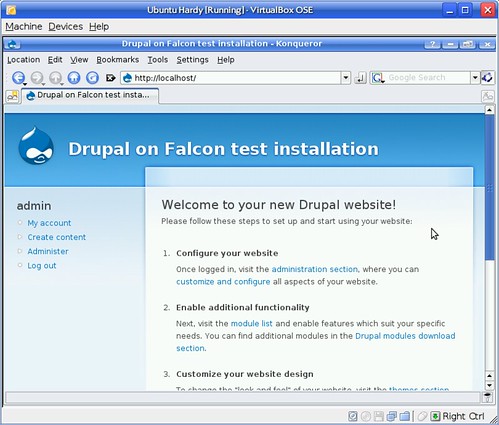 This article describes how to install the Drupal 6.2 CMS on MySQL 6.0, using the Falcon Storage Engine. The operating system is a default Ubuntu 8.04 "Hardy Heron" (x86) installation.
I will make a few assumptions here, in order to keep the instructions simple: a fresh OS install, no other MySQL databases or web services are running or have already been installed. Both MySQL and the web server are installed on the same host. You should be able to become root to install packages and to have access to the local file system and the system configuration.
This article will explain how to install and configure Apache/PHP, MySQL 6.0 and Drupal 6.2.
Continue reading "Running Drupal 6 on MySQL 6 using the Falcon Storage Engine"
While being subscribed to the full blogs.sun.com feed certainly feels like drinking water from a firehose, every once in a while I stumble over very well-written and useful articles about MySQL. Below is a collection of helpful posts, especially if you run MySQL on Solaris (surprise!). And while I still am an avid Linux user, I must admit that Solaris has a few neat features - particularly DTrace and ZFS are quite intriguing. If only userland would not feel so weird for someone coming from a GNU/Linux background!
From Jenny Chen's blog:
From Ritu Kamboj's blog:
From Krish Shankar's Blog:
More to come in the near future!

KAs during last year's MySQL Conference, we invited Julian Cash to take pictures of some attendees. I managed to get my picture taken in last second - the hotel staff was already complaining that they need to redecorate the room for the next event...
The results of this foto session are now on Julian's photo stream on Flickr - I am really impressed by the results! This puts a whole new meaning to the term "MySQL Luminaries" 
Kaj's pictures are pretty funny, too - is this an interpretation of "MySQL Community" vs. "MySQL Enterprise"?


JFYI, I now placed a PDF of my MySQL Conference talk slides about "Performing MySQL backups using Linux LVM Snapshots" on my MySQL talks page. Enjoy!
While reading Colin's post about LugRadio Live, I stumbled over the Zumastor Linux Storage Project. Going through the project home page and their HOWTO got me curious - could this eventually become an alternative to using DRBD (for replicating data) and LVM snapshots (for performing backups)?
Zumastor is Free software that adds enterprise storage features (primarily improved snapshots and remote replication) to Linux.
Snapshots
LVM already lets administrators create snapshots, but its design has the surprising property that every block you change on the original volume consumes one block for each snapshot. The resulting speed and space penalty usually makes the use of more than one or two snapshots at a time impractical.
Zumastor keeps all snapshots for a particular volume in a common snapshot store, and shares blocks the way one would expect. Thus making a change to one block of a file in the original volume only uses one block in the snapshot store no matter how many snapshots you have.
Replication
Andrew Tridgell's rsync is a wonderful tool for replicating files remotely. However, when doing periodic replication of large numbers of infrequently changing files, the overhead for figuring out what files need to be sent can be extreme.
Zumastor keeps track of which block change between one snapshot and the next, and can easily send just the changed blocks. Thus Zumastor can do frequent replication of large filesystems much more efficiently than rsync can.
I assume it's not ready for production use yet, but it would sure be interesting to investigate on how to utilize it for the purpose of running MySQL on top of it...
I will keep an eye on this project, I wonder if I will have to add support for Zumastor snapshots to mylvmbackup at some point?
FYI, I changed two parameters on Planet MySQL to accomodate the current flood of postings coming from the MySQL Conference attendees: we now display the last 25 posts (instead of 10) on the front page, the RSS feed now includes the latest 100 posts (instead of 50). This should make sure that posts actually make it to the front page for at least some time, before they fall off again.
Please keep up the good blogging!
