Skip to content

FrOSCon/OpenSQL Camp summary


It's almost two weeks now since FrOSCon and the OpenSQL Camp subconference have taken place in Sankt Augustin, Germany — about time for a summary and update from my side!

First off, I would like to thank all of the participants and supporters, particularly my colleagues Regina Steyer and Iris Musiol for the perfect logistics and co-sponsoring as well as Uli Graef, Thorsten Frueauf, Matthias Schmidt, Alexander Rubin and Joerg Moellenkamp for manning the Sun booth and the help on site.

Another big Thank You goes out to my team mates Giuseppe and Colin as well as to Sheeri K. Cabral, who were a big help in keeping the OpenSQL Camp on track and by supporting the event by giving talks. In addition to that, Sheeri recorded most of the OpenSQL Camp sessions on video and published them in record time!

So here's a quick summary of both events from my side, starting with the main conference.

Sun was a Gold sponsor of the event and we had a booth right at the main entrance area; it could hardly be missed. It consisted of two large and two small desks as well as a divider behind them. For demos, we had a (slightly noisy) Sun Fire X2200 M2 Server and four SunRay 2 Thin Clients (which by themselves triggered a lot of questions and curiosity by many visitors). The booth was flanked by rollup-banners on both sides as well as various posters attached to the divider. Here's a picture of our booth before the event opened:
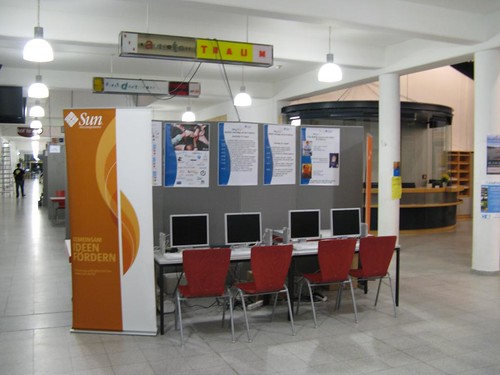
img_4690

We demoed Open Solaris, Open HA Cluster, NetBeans/Java and MySQL. We also had a lot of brochures about various products, OpenSolaris 2009.06 Live-CDs incl. booklets as well as some MySQL-T-Shirts to hand out. We distributed over 300 CDs and received a lot of positive feedback about the distribution.

We also had a number of talks in the main conference track (both German and English):

The comments and ratings of these sessions were generally very positive. Our booth was well attended, especially during the session breaks. In total, there were over 1.400 visitors at the conference over the two days.

I personally did not attend many sessions in the main conference tracks, as I was too occupied with the OpenSQL Camp and the booth organization. However, I managed to listen to Uli Graef's talk, which was a very technical and interesting session about ZFS features and internals. Being a big fan of ZFS myself, this was a very worthwhile session to be at and my impression was that it encouraged others to take a closer look at this truly amazing file system.

The second talk I attended was Sunday's keynote by Dries Buytaert from the Drupal project about "The Secrets of Building and Participating in Open Source
Communities
". Dries is a great speaker with visually stunning slides. He is funny, too — if you have a moment, you should watch the video recording of his keynote. An uncut "pre-release" version of his talk is already available as an OGG Video file.

As for previous FrOSCons (is that the proper plural?), there was a social event scheduled for Saturday evening, providing barbecue (Steaks and Sausages as well as vegetarian dishes) and drinks. This event usually takes place outside and is always an excellent opportunity for networking and talking with key people from other OSS communities and projects. And there was plenty of time for talking - the queues for the grilled food were long...

Here is a list of other blogs and articles about FrOSCon that are worth a read (in no particular order and both German and English):


OpenSQL Camp, European Edition

In addition to the main conference tracks, FrOSCon also provided a number of so-called "Developer Rooms" to OSS projects, so that they could organize sub-conferences or hackfests of their own. We applied for a room to set up a conference dubbed "OpenSQL Camp", related to the topic of Open Source databases, which was approved.

We then sent out a call for papers and invited people from the many OSS database communities to join us and talk about their projects. Every session proposal was published on the OpenSQL Camp web site and people were able to vote on the sessions they were most interested in via email or twitter:

The organization and scheduling of the talks and speakers was done via the FrOSCon conference system (Pentabarf), which made it very easy to perform this task and also made sure that the OpenSQL Camp sessions were included in the main conference program. Below is a full list of sessions at our subconference (see the FrOSCon Program page for abstracts, speaker info, links and slides). We had two cancellations by speakers on short notice, but were able to cover the gaps with ad-hoc presentations. I'd like to send a special thanks to Geert Vanderkelen, who gave a great presentation about MySQL Cluster despite the very short notice and some technical difficulties at the beginning!

Most talks attracted between 20-50 attendees and we had a great mix of topics from several different database projects (with a slight majority of MySQL-related talks). The Panel Discussion (moderated by me), called the "OSS Toolshed Shootout" went quite well and the speakers had a good time answering questions on various topics about their projects. Thanks again to all OpenSQL Camp speakers for making this event a success!

All in all I think that both FrOSCon and OpenSQL Camp were well worth supporting and attending - we were able to provide insight and trigger some interesting discussions among the OSS enthusiasts and developers in the audience. It was also a good opportunity in get in touch with many people of other OSS communities, fostering the MySQL (and other Sun OSS projects) ecosystem.

Here is a Flickr slide show of my own pictures - more photos can be found in the FrOSCon Gallery and the links page on the Wiki.

I personally look forward to next year's FrOSCon - a Big Thanks to the organizers for another great event!

Seeking talks for a MySQL Day at this year's International PHP Conference (Nov 15-18)

IPC 2009, the International PHP Conference will take place on November 15th-18th in Karlsruhe, Germany. While the deadline for the call for papers for the main conference program has already passed, there is still an opportunity to submit MySQL-related content: the organizers plan to have a special MySQL Day, which will take place on Tuesday, 17th of November.

Quoting for the Call for Papers web page:

We are looking for speakers joining the Architecture Day or the MySQL Day. "Architecture", in terms of project organization, business organization, tools & approaches etc. is becoming a key qualification to developers and teams. And MySQL still is one of the most common open source databases used in many of todays leading web applications. The International PHP Conference will provide attendees with professional and up to date information on both MySQL and Architecture in the world of PHP.

We are looking forward to you numerous suggestions and proposals, as usual via http://phpconference.com/input.

We would like to encourage you to support and contribute to this event by submitting interesting talks related to MySQL and PHP! If you have any questions or comments about this MySQL Day, feel free to get in touch with Robert Lippert or Björn Schotte directly. Thank you!


Solaris/OpenSolaris distributions - an overview

OpenSolaris LogoThere have been several similar articles to this one, but I find it pretty amazing to see all these emerging and established Solaris/OpenSolaris distributions. It's a good sign of a healthy community!

So here is my collection - please let me know if I forgot one.

Maintained by Sun Microsystems:

  • Solaris 10: The commercial, production-ready and full supported version, similar to Red Hat Enterprise Linux (RHEL) or SUSE Linux Enterprise Server (SLES).
  • OpenSolaris: This is the "official" OpenSolaris distribution, developed & supported by Sun. Can be compared to Fedora or openSUSE Linux - this is the version which will become the basis of future "Enterprise" releases with a different support and maintenance model. The developers aim on publishing a release roughly every six months.
  • Solaris Express: Community Edition (SX:CE): is Sun's periodically built unsupported distribution of OpenSolaris (along with many additional open-source and a few closed-source components necessary to make a complete installable system). However, it looks as if Sun plans to discontinue the production of this version soon.
  • Solaris Express: Sun's official distribution of OpenSolaris. These are provided primarily for customers interested in trying out new features of the Solaris release currently under development without the total cutting-edge-ness of the Solaris Express: Community Edition

Third-party distributions (in alphabetical order):

  • AuroraUX: A core operating system for high integrity scientific computing. AuroraUX is a Solaris-derived kernel- and user- land. The core of the project are its utilities written in Ada. When necessary, poorly implemented features get fixed or rewritten, as well.
  • Belenix: BeleniX is an OpenSolaris Distribution with a Live CD (runs directly off the CD). It can be installed to harddisk and is free to use, modify and distribute.
  • Embedded Operating system/Networking (EON): A RAM-based live ZFS NAS appliance (CIFS/NFS/Samba) that boots from USB.
  • Jaris: An OpenSolaris derivative suitable for Japanese users, providing a windows-like environment. (The web site is available in Japanese only)
  • Korona: A live DVD distribution based on OpenSolaris, but using KDE 4.3 as the default desktop.
  • Martux: A barebones OpenSolaris distribution for SPARC
  • MilaX: MilaX is a small size Live CD distribution which runs completely off a miniCD, bootable business card or USB flash drive.
  • Nexenta Core: Basically an OpenSolaris Kernel with an Ubuntu/GNU userland (including an improved version of apt-get that utilizes ZFS snapshots to perform rollbacks of failed upgrades)
  • SchilliX: The very first independent OpenSolaris-based distribution (seems like it's not maintained anymore)
  • StormOS: an OpenSolaris desktop distribution, based on Nexenta Core

More MySQL connectors

Some time ago I posted a compilation of applications and programming languages that provide an API to connect to the MySQL Server. As it turned out, I forgot a few that I would like to mention here:

  • Apache DBD API: a MySQL driver for mod_apr_dbd is not included in the official distribution, but can be obtained seperately from here. Some distributions (e.g. openSUSE) actually provide installable packages of this driver module.
  • GRASS MySQL driver: The MySQL database driver in GRASS enables GRASS applications to store vector attributes in a MySQL server. Alternatively, data can be stored in an embedded version of the MySQL Server.
  • HDBC: HDBC provides an abstraction layer between Haskell programs and SQL relational databases. This lets you write database code once, in Haskell, and have it work with any number of backend SQL databases.
  • libdrizzle: This is the client and protocol library for Drizzle and MySQL that provides both client and server interfaces. A number of APIs (e.g. Java, Lua, Perl and Ruby as well as Python) have been built on top of it, but I'm not quite sure if they all support the MySQL client/server protocol as well.
  • MySQL Connector/Python: MySQL Connector/Python is implementing the MySQL Client/Server protocol completely in Python. This means you don't have to compile anything - the MySQL client library doesn't even have to be installed on your system.

Do you know of any other MySQL Connectors/APIs? Let me know!

OpenSQL Camp 2009: Session schedule published - pre-register now!

OpenSQLCamp.org Logo

I'm happy to announce that the schedule for OpenSQL Camp 2009 (European Edition) has been published on the FrOSCon timetable now. We have a great selection of topics and speakers, so don't miss it! OpenSQL Camp is a subconference of FrOSCon, the Free and Open Source Conference, which will take place on August 22nd and 23rd in St. Augustin, Germany.

The admission fee for the entire conference (both days, incl. OpenSQL Camp) is 5 EUR, you can pre-register here until August 10th (and if you do so today, you will still get a free T-Shirt as well!). Of course, you can also just show up at the entrance and pay the entrance fee on site. The OpenSQL Camp will be located in Room C120 - see the instructions on the FrOSCon web page on how to get there and where to find accommodation.

In case you can't make it to Germany for the European Edition, Eric Day and Selena Deckelmann have started to organize another OpenSQL Camp in Portland, Oregon which will take place on November 14th and 15th. More details can be found on the OpenSQL Camp Wiki. Space is limited to 120 attendees, so sign up today and reserve your spot!

Updated MySQL 5.1.35-GIS snapshot binaries are now available

We've now published a new set of binary packages including the extended GIS functionality from the mysql-5.1-wl1326 source tree.

This release is based on the MySQL 5.1.35 code base and fixes the bugs mentioned below. It includes some improvements to the GIS functionality as well, so please use these packages for future testing of the MySQL GIS functionality.

The following GIS-related bugs were fixed in this version:

  • Bug#31753: Buffer/area functions only return first row of set
  • Bug#32032: Contains() does not work on MultiPolygons, may force a disconnect and/or result in extremely long query times.
  • Bug#32100: contains, intersects functions never return. Query disconnects or times out.
  • Bug#33035: Intersection function returns 'Function doesn't exist' error
  • Bug#40874: Buffer function doesn't work with LINESTRING
  • Bug#41481: Buffer function never returns, cpu 100%, system locks up
  • Bug#43493: union function returns polygon not multipolygon for non-intersecting polygons
  • Bug#44753: nan error in union function

I'd like to explicitly thank John Powell for his extensive testing and bug reporting so far, he helped us quite a lot to improve the quality of the GIS code.

Please help us by by testing this new release and reporting bugs at our public bug database. For convenience, please tag your Bug reports with "gis" and make sure to put them in the "Server: GIS" category!

OpenSQL Camp 2009: CfP has ended, vote for your favourites until July 26th!

OpenSQLCamp.org Logo

The Call for Papers for the OpenSQL Camp 2009 (European Edition) has ended yesterday — we received 27 excellent session proposals from various Open Source Database projects. I would like to say a big "Thank You" to everyone who submitted a talk! In the beginning I was a bit concerned that the conference would become too MySQL-centric, but this fortunately changed in the last few days.

Sadly we now have more than double the amount of sessions than we can actually host, which means that we will have to review and vote on the sessions to distill the final program. We've formed a small committee that will perform this task (currently consisting of Sheeri, Giuseppe and myself) and is in charge of finalizing the schedule. But you can help us with this! We are seeking your input on which sessions you would like to attend until Sunday, July 26th (12:00pm PST).

The system basically asks for "one vote per person per session", giving you a chance to influence the program yourself: you can cast one vote for each session by either stating you would be interested in attending it (+1) or not interested (-1). Additionally, you can add a comment for each vote to provide a reasoning for your choice. Ideally, you should of course plan to actually attend our event, but you are welcome to tell us what you would have been interested in, in case you can't make it to the Camp. See the OpenSQL Camp wiki page for more details and instructions. You can submit your votes via Twitter or the OpenSQL Camp mailing list.

We look forward to your input!

OpenSQL Camp 2009: List of current session proposals; keep them coming!

I've now posted all the current talk submissions to the OpenSQL Camp Wiki. A big Thank You to everyone who contributed so far and helped us to bang the drum for this event! If you haven't heard about OpenSQL Camp yet, it's a subconference of the Free and Open Source Conference (FrOSCon) in St. Augustin, Germany, which takes place on August 22+23. The topic of OpenSQL Camp is "Open Source databases and related technologies" and we're looking for interesting presentations in this field.

As we have 12 session slots to fill, we still have room for at least 6 more submissions! It's also a tad bit MySQL-centric at the moment, that should definitely change! We would love to get some more diversity to cover a broader range of Open Source Database technology.

So please submit your talk proposals and help spreading the word — the Call for Papers is still open until July, 19th! Post a message to relevant discussion forums and mailing lists. Know an expert in this field? Approach him directly! OpenSQL Camp Speakers will receive free entry to FrOSCon, which is worth visiting in any case!

FlightGear 1.9.1 now added to the openSUSE Build Service

I admit it — I'm a fan of simulation software, particularly flight simulators. Probably the best Open Source Flight Simulator out there is FlightGear — it provides an impressive level of reality and you can download and install many additional plane models and terrains. There are packages of FlightGear 1.0.0 in the games repository of the openSUSE Build Service, which works quite well and I have been enjoying it a lot. However, the FlightGear project released version 1.9.x quite a while ago (1.9.1 was published in January 2009) and I was itching on giving the new version a try (just take a look at the screenshots and you know what I mean). However, building FlighGear on Linux is quite a complex task with many dependencies, and so held off from doing it myself, waiting for someone else to perform the update...

Well, this weekend I finally bit the bullet and did it myself - FlightGear 1.9.1 has now been added to my home:LenzGr build repository. I based my packages on the ones included in the games repository, but I plan on cleaning them up a bit and splitting them into separate packages (currently the FlightGear source RPM contains SimGear and fgrun as well). I also "borrowed" the OpenSceneGraph sources and spec file from the PackMan repository, in order to have a functional build. Unfortunately FlightGear currently only builds on a very limited list of distributions so far (namely OpenSUSE 11.0, just what I needed) — I haven't had time to adapt the spec files for FlightGear and OpenSceneGraph to match the appropriate build dependencies for the other distributions yet and "02-check-gcc-output" gives me some grief on platforms where it actually builds but generates compiler warnings (but patches are welcome!)...

MySQL University session recording: MySQL Code Contributions

MySQL University Logo

Last week I gave a MySQL University Presentation about how to contribute code to MySQL. This time DimDim did not fail to record the session, even though there is a funky overlap of audio from Stefan Hinz (the moderator) and myself at the beginning. I had a bit of a slow start into the presentation, because of a very nasty headache that plagued me that day. But we had a lively discussion at the end and I hope it was useful to the participants.

In case you have missed it, you can now watch the playback or download the session slides:

Embedded InnoDB 1.0.3.5325 RPM packages

Shortly after I created the initial packages of embedded InnoDB on the OpenSUSE Build Service, Oracle/Innobase released an updated version (1.0.3.5325). In addition to many improvements and bug fixes, they slightly changed the versioning scheme to better indicate what version of the InnodDB plugin their code is based on (see Vasil's posting on the InnoDB Forums for more information).

I've now updated my InnoDB packages on the Build Service to this version as well - please note that the naming scheme of the shared library package has been changed from "embedded_innodb1" to "libinnodb2" — RPM will take care of replacing the old package during update, even though the name has changed.

Embedded InnoDB now available on the openSUSE Build Service

Oracle/InnoBase announced the availability of the embedded version of InnoDB at this year's MySQL Conference & Expo, but I have not seen a lot of comments or reviews about it so far. Which surprises me, because I think this is a very interesting piece of technology!

In my opinion it might actually hit the sweet spot for application developers seeking an alternative embedded database solution. SQLite is nice and popular, but it seems to have concurrency issues when used in multi-threaded applications. An embedded MySQL server would be an alternative - this is what the Amarok developers decided to go with, for example. But this approach has its issues, too, especially the lack of a shared library version of libmysqld poses some challenges when distributing binaries.

This is where I think the embedded version of InnoDB might have an edge. It's pretty lightweight in comparison to a full-blown MySQL server, provides excellent crash-recovery (which is essential for desktop applications), transactions (useful in environments with high concurrency) and foreign key constraints. I'm not sure how important these are for embedded use cases, it probably depends on the complexity of the data to be stored. On the downside, Embedded InnoDB does not "speak" SQL. In order to store and retrieve values, you need to use the InnoDB API. See the chapter Concepts and Architecture for more details and an overview.

Another possible reason for the low popularity might be that it's currently not part of any Linux distribution (yet) and that Oracle only provides binary tarball packages for Linux and a Windows binary for download from the web site.

Therefore I've now created a spec file to build RPMs of Embedded InnoDB and added it to my repository on the openSUSE Build Service, which now provides Embedded InnoDB packages for a wide range of RPM-based Linux distributions. I hope that the spec file will be included in the next source distribution. I've posted it (and a patch to fix a few problems with the examples) to the newly created InnoDB mailing list, but to be sure I added a note to the Embedded InnoDB Forum as well.

mylvmbackup-0.12 has been released

After a long hiatus, I am happy to announce that mylvmbackup version 0.12 has now been released. This release includes a large number of improvements, minor code cleanups, as well as some new functionality. In particular, I would like to thank Matthew Boehm, Tim Stoop, Baron Schwartz, Ville Skyttä and Ronald Bradford for their contributions.

Some notable highlights from the ChangeLog:

  • Removed the absolute path names to external tools (make sure $PATH is correct)
  • Added --log-err to the startup options of the recovery instance to avoid cluttering the server's error log
  • Added support for hooks written as Perl Modules. (Matthew Boehm)
  • Added support for date/time-formatted path names for backupdir and mountdir (Matthew Boehm)
  • Backupdir and mountdir are now created automatically (Matthew Boehm)
  • Added new hook "logerr" when an error is logged. (Matthew Boehm)
  • Added Option --keep-mount... (Tim Stoop)
  • Removed the bind mount, now requires LVMv2
  • Support reading login/password from ~/.my.cnf (Baron Schwartz)
  • Documentation fixes and improvements (Ville Skyttä) (Bug #302144)

Another useful tool for organizing MySQL User Group Meetups: Eventbrite

Eventbrite Logo

Giuseppe stumbled over this website and recommended it to me as a potential useful service for organizing the registrations of the OpenSQL Camp: Eventbrite is a Python/MySQL-powered web site (judging from their job openings) that provides the following:

Eventbrite is the leading provider of online event management and ticketing services. Eventbrite makes it easy for anyone to hold a successful event of any type and size. Eventbrite is free if your event is free. If you sell tickets to your event, Eventbrite collects a small fee per ticket. So just like you, Eventbrite wants your event to be a big success.

The Eventbrite service includes many features and tools intended to let you perform three basic tasks really well:

  1. Publish: Everything you need to create and easily personalize a custom web page for your event.
  2. Promote: The tools you need to spread the word about your event and maximize attendance.
  3. Sell: The immediate power to sell tickets and collect money online.
I won't use it for the OpenSQL Camp (as we will be able to piggyback on FrOSCon's event infrastructure), but it seems like a service worthwhile checking out, if you're looking for a way to organize your next MySQL meetup (and you're based in the US - currently Eventbrite seems to assume USD as the only available currency). I've added a note about it to the suggestions on the how to run a MySQL User Group page on the MySQL Forge Wiki. And if you do use it, please make sure to add your group to the list of MySQL User Groups! Thanks.

Searching the service for "MySQL" revealed that the MySQL Dublin Meetup actually uses it for organizing their upcoming meeting (June 24, but already sold out)!

MySQL Error of the day

Just spotted the following posting from Paul DuBois on the internals mailing list:

I'm engaged in a project (WL#3403) to compile information that will provide better information about our errors and error messages:
  • What an error means
  • Likely causes of the error
  • How to rectify or work around the error

The general idea is to provide our users something more than a list of error codes and the messages from errmsg.txt, such as the manual currently includes here:

http://dev.mysql.com/doc/refman/5.1/en/error-messages-server.html
http://dev.mysql.com/doc/refman/5.1/en/error-messages-client.html

To that end, and to give lucky YOU a chance to participate in this exciting (!!) project, I'd like to solicit your knowledge on a case by base basis. To that end, I'll post individual messages for different errors, indicating what I know about them and asking for additional comments. I hope in this way to take advantage of the knowledge that different developers have about errors that pertain to their particular areas of expertise.

I think this an excellent initiative, as some of the error messages are quite confusing/misleading!

And without further ado, Paul already started with his first post: Error of the day: ER_HASHCHK - which according to Kostja is not actually used...

tweetbackcheck