Skip to content

Please give us your feedback by taking the MySQL Magazine Survey!

If you are working with MySQL as a DBA or developer, I'd like to encourage you to consider taking the MySQL Magazine Survey, which was compiled by Keith Murphy and Mark Schoonover.

The survey takes around 10-15 minutes to complete and runs until June 16th. The results will be published in the summer issue of MySQL Magazine, due on July 15th. The questions cover a broad range of topics, from details about your MySQL experience and job description over connectors and languages to operating systems and MySQL versions.

Thanks in advantage for your support and input! The results of this survey will be interesting for us as well.

Sun & MySQL at Linuxtag 2008 Berlin (2008-05-28/2008-05-31)

From May 28th-31st, the annual LinuxTag will take place in Berlin, Germany. I followed the growth and evolution of LinuxTag from the very early days and I have fond memories of the event back when it still took place at the University of Kaiserslautern and our SuSE "booth" was just a regular table taken from the lecture rooms...

Things have evolved a lot since then. Today, LinuxTag is one of the largest Linux/Open Source Events in Europe and my new employer Sun is a major sponsor this year. In addition to several talks and keynotes, there will be a large Sun booth in the exhibition area (Booth #205) and we will have a dedicated MySQL demo pod! Some of the things we plan to demo there are the upcoming MySQL Server releases (5.1, 6.0 with Falcon and Online Backup), MySQL Workbench, MySQL Enterprise Monitor as well as how to combine these with other Sun products like Glassfish, NetBeans, OpenSolaris or OpenOffice.

Some other stuff that we will be showcasing on the Sun booth:

  • Be Brilliant Faster with OpenSolaris: Develop, Debug, Deploy Apps Faster with ZFS and Dtrace, OpenSolaris Live CD – Fast, Free, and Easy to Install
  • Virtualize Your Business with xVM and VirtualBox: OpenSolaris, Windows, Linux & Mac OS X Virtualized, Develop on VirtualBox, Deploy on xVM, Free & Open
  • Sun Studio Software for OpenSolaris and Linux: C/C++/Fortran Compilers and Tools, x86 and SPARC
  • Cool New Features in OpenOffice.org 3.0: Importing PDFs and Managing Appointments, now with full support for MAC OS X (Aqua)
  • Discovering Open High Availability Cluster: Overview about HA Clusters, Community Group Projects, Single Node Cluster – Service Failover between Zones
  • GlassFish - the Open Source Java EE 5 Application Server: JRuby/ Rails, Ajax & Comet

I look forward to being there! Please contact me, if you are interested in visiting Linuxtag and would like to receive a free pass!


MySQL won the LinuxJournal Readers' Choice Awards 2008!

There were free copies of the Linux Journal handed out to attendees outside in the hallways here at CommunityOne and I noticed that they just published this year's Readers' Choice Awards - MySQL was voted as the favourite database by 62.7% of their readers!

MySQL is not only the world's most popular open-source database, it's your favorite as well. Although PostreSGL,
SQLite, Firebird and others registered votes, the competition was not fierce. It doesn't hurt that MySQL runs on more than
20 different platforms.

Thanks a lot to the readers of LinuxJournal, we really appreciate the support!

Hello from San Francisco!

Just two weeks after having returned from the MySQL Conference, I just arrived safely in San Francisco again. This time to attend the CommunityOne on Monday and the JavaOne conference from Tuesday till Friday, which should keep me occupied for the rest of the week. I look forward to meeting my fellow MySQL team members (Colin, Giuseppe and Jay will be here, too), as well as many new colleagues from Sun! Shoot me an email, if you would like to meet.

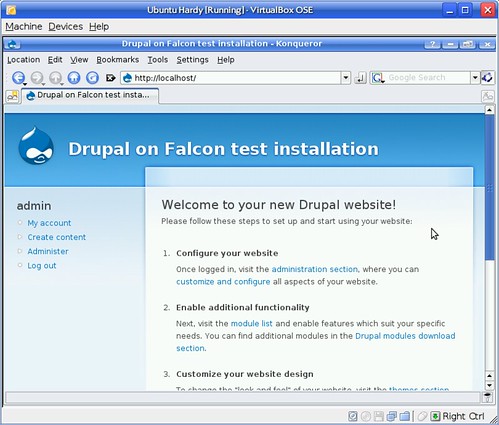
Running Drupal 6 on MySQL 6 using the Falcon Storage Engine

This article describes how to install the Drupal 6.2 CMS on MySQL 6.0, using the Falcon Storage Engine. The operating system is a default Ubuntu 8.04 "Hardy Heron" (x86) installation.

I will make a few assumptions here, in order to keep the instructions simple: a fresh OS install, no other MySQL databases or web services are running or have already been installed. Both MySQL and the web server are installed on the same host. You should be able to become root to install packages and to have access to the local file system and the system configuration.

This article will explain how to install and configure Apache/PHP, MySQL 6.0 and Drupal 6.2.

Continue reading "Running Drupal 6 on MySQL 6 using the Falcon Storage Engine"

Zumastor as an alternative for LVM/DRBD?

While reading Colin's post about LugRadio Live, I stumbled over the Zumastor Linux Storage Project. Going through the project home page and their HOWTO got me curious - could this eventually become an alternative to using DRBD (for replicating data) and LVM snapshots (for performing backups)?

Zumastor is Free software that adds enterprise storage features (primarily improved snapshots and remote replication) to Linux.

Snapshots

LVM already lets administrators create snapshots, but its design has the surprising property that every block you change on the original volume consumes one block for each snapshot. The resulting speed and space penalty usually makes the use of more than one or two snapshots at a time impractical.

Zumastor keeps all snapshots for a particular volume in a common snapshot store, and shares blocks the way one would expect. Thus making a change to one block of a file in the original volume only uses one block in the snapshot store no matter how many snapshots you have.

Replication

Andrew Tridgell's rsync is a wonderful tool for replicating files remotely. However, when doing periodic replication of large numbers of infrequently changing files, the overhead for figuring out what files need to be sent can be extreme.

Zumastor keeps track of which block change between one snapshot and the next, and can easily send just the changed blocks. Thus Zumastor can do frequent replication of large filesystems much more efficiently than rsync can.

I assume it's not ready for production use yet, but it would sure be interesting to investigate on how to utilize it for the purpose of running MySQL on top of it...

I will keep an eye on this project, I wonder if I will have to add support for Zumastor snapshots to mylvmbackup at some point? :-)


mylvmbackup 0.8 has been released

I am happy to announce the release of mylvmbackup version 0.8. mylvmbackup is a tool for quickly creating backups of a MySQL server's data files. To perform a backup, mylvmbackup obtains a read lock on all tables and flushes all server caches to disk, makes an LVM snapshot of the volume containing the MySQL data directory, and unlocks the tables again. The snapshot process takes only a small amount of time. When it is done, the server can continue normal operations, while the actual file backup proceeds.

Below is the list of changes since version 0.6. You may wonder what happened to version 0.7 - it had a rather short life cycle as I was informed about a bug that I fixed quickly before I made a wider release announcement of 0.7.

  • Fixed a bug in the InnoDB recovery function: the second mysqld process clobbered the socket file of the primary MySQL instance (thanks to Alain Hoang for reporting this)
  • Updated the man page, noted some other limitations of the InnoDB recovery function
  • Bug fix: use the correct mysqld parameter to provide an alternative PID file (--pid-file instead of --pidfile) - thanks to Guillaume Boddaert and Jim Wilson for reporting this!
  • Added option "--skip_mycnf" to skip including a copy of the MySQL configuration file in the backup, added a safety check that the file actually exists prior to backing it up.

Updated package are available from the home page and via the openSUSE Build Service as usual. Updated packages for Debian/Ubuntu and Gentoo Linux should also be available shortly. Enjoy!

Speaking of LVM snapshot backups: I will be giving a talk about this subject at our MySQL Conference 2008 in Santa Clara, CA next week. If you are curious about how MySQL can be backed up using this technology, please consider to stop by!


Interview on Impackt '08

Impackt '08 LogoI recently was interviewed by Packt Publishing for their Impackt '08 web pages:

Ever since the formal adoption of the term in 1998, Open Source has experienced growth and adoption rates that defy pressures and suggestions that it’s a viable option for enthusiasts and geeks only. Governments, corporations as well as small businesses have begun to choose Open Source over proprietary software. However, with the global economy facing an uncertain future, how will open source be impacted? Can it continue to grow despite this?

With these questions in mind and more, Packt approached some people at the heart of this movement to understand their take on the future of open source.

The interview has now been published. Enjoy!


My Google Summer of Code project idea: PlanetMySQL improvements

A bit late in the game, but maybe somebody would be interested in working on this proposed project of mine:

PlanetMySQL currently is merely an aggregator of submitted RSS feeds, with some functionality for filtering content to keep the discussion on topic. Due to its high volume of posts, many gems get "lost in the noise" and are hard to retrieve.

We'd like to expand the functionality of PlanetMySQL significantly to provide more possibilities for community participation and interaction. For this project, we are looking for a talented PHP hacker to set up a site that provides the current functionality and more:

  • Voting on articles/blog postings: it must be possible for logged in users to cast a vote on articles, similar to the Perlmonks.org voting system. This would allow providing different RSS feeds, e.g. only articles that have a certain rating and rankings for articles and authors. Positive votes accumulate and increase the "karma" value of the individual author as well as identifying the quality of a particular posting.
  • Archiving/Tagging/Searching: it must be possible to add tags to the aggregated blog postings, to ease the searching of older articles and to facilitate the creation up of a searchable "Community Knowledgebase"
  • Authentication: User logins must use the same username/password pair as MySQLForge and the rest of the mysql.com web site (to reduce duplication and allow better integration with other parts of MySQL Forge, e.g. the user profile page)
  • Optionally, it should be possible to comment/discuss on the aggregated articles directly on the new PlanetMySQL site. These comments should be sent back to the original blog via Trackbacks (if applicable)
  • It should be possible to group feeds from multiple, different authors as a "Team Feed", to allow rankings by Team/Group in addition to the ranking of individuals
  • The site must provide Unicode support to allow the handling of postings in multiple languages (e.g. Japanese, Chinese)
  • New feed submissions should not be subscribed automatically, but rather should be reviewed by a moderation team first (to avoid spam and off-topic feeds)

The implementor should first make an assessment if these new functions should be developed on top of the existing code base, or if it would make sense to rebuild the existing functionality plus the new features on top of an existing PHP Framework (e.g. Drupal, Silverstripe, Symfony or similar). Making use of Web2.0 techniques (AJAX) is encouraged, if it makes the site easier to use and visually appealing.

Please contact me directly (firstname at MySQL.com) or the mailing list, if you are interested in working on this task. Thanks!


Reminder: MySQL Meetup Mashups in Germany next week (Hamburg and Berlin)

A gentle reminder: next week, there will be two more stops of the MySQL Meetup Mashup Tour:

  • Monday, April 7th, 19:00: Hamburg, Germany. We will meet in the meeting rooms of the local Sun Microsystems offices ( Nagelsweg 55, 22097 Hamburg). There will be two technical sessions: Giuseppe will talk about the MySQL Sandbox, Kay Koll will give a presentation about how to combine MySQL with OpenOffice.org. He will also describe the new report generator and give an overview over the future of OpenOffice. You can register for this event via meetup.com or Xing.com.
  • Tuesday, April 8th, 17:00: Berlin, Germany. This event will take place in the rooms of the Berlin offices of Sun Microsystems (Komturstrasse 18a, 12099 Berlin). This time, Giuseppe will talk about MySQL as an open platform, Kristian Köhntopp will share a few hints he gathered while doing consulting work at customer sites. Please use Xing.com to register for this event.

At both events, colleagues from Sun and MySQL will be present to answer questions and discuss the acquisition of MySQL by Sun and all things Open Source. There will be free drinks and food as well!

We look forward to welcome users from the various related Sun products/projects, e.g. OpenOffice, Java, OpenSolaris, Glassfish or Netbeans. There is so much opportunity for collaboration and exchange of experience - I am very excited to be at both meetings to meet and talk with people from these communities. See you there! 


Going to the Sun/MySQL Meetup Mashup in Munich this Friday

As Kaj already pointed out, the Sun/MySQL Meetup Mashup Tour will also make a stop in Munich, Germany this Friday. I will be there as well, we will meet at 14:00 at the Hilton Munich Park Hotel. Kaj and some other Sun people will join us a bit later. If you are in the area, make sure to stop by!

By the way, the Meetup Mashup Tour will make at least one more stop in Germany - I am organizing an event in Hamburg, Germany which will take place on Monday, April 7th (19:00). This was initially planned as another regular MySQL Meetup, but I offered to expand the scope a bit. We will now meet at the Sun offices, Sun will sponsor some food and drinks! In addition to the usual MySQL Meetup crowd, we expect participation from various Sun communities (e.g. OpenOffice/StarOffice, Java or OpenSolaris). As usual, there will be a MySQL tech talk (this time held by Giuseppe).

I look forward to this event - it will be exciting to mingle with the people from these other communities and to exchange experiences and make new contacts. If you live somewhere around the Hambur area and would like to participate, please RSVP via Meetup.com or Xing.com soon!


Embedding a MySQL Server in C/C++ or Java applications

Last week at CeBit I once again had a conversation with an application developer that was not aware that it's possible to embed the MySQL Server inside an application instead of running it as a separate process. I experienced something similar at FOSDEM recently, while talking with the Amarok developers - how come that this feature is so little known? In fact, there are two possibilities for embedding MySQL (and both of them are licensed under the GPL): the first one is using the libmysqld embedded library, which is suitable if you are developing C/C++ applications:

The embedded MySQL server library makes it possible to run a full-featured MySQL server inside a client application. The main benefits are increased speed and more simple management for embedded applications.

The embedded server library is based on the client/server version of MySQL, which is written in C/C++. Consequently, the embedded server also is written in C/C++.

The API is identical for the embedded MySQL version and the client/server version.

Especially consider the last sentence - it's actually fairly easy to create an application that supports connecting to both an embedded or a standalone server instance! Here are some related links to get you going:

If you're a Java developer, you should consider taking a look at our Connector/MXJ product - this allows you to embed a MySQL server in your Java application:

MySQL Connector/MXJ is a Java Utility package for deploying and managing a MySQL database. Deploying and using MySQL can be as easy as adding an additional parameter to the JDBC connection url, which will result in the database being started when the first connection is made. This makes it easy for Java developers to deploy applications which require a database by reducing installation barriers for their end-users.

MySQL Connector/MXJ makes the MySQL database appear to be a java-based component. It does this by determining what platform the system is running on, selecting the appropriate binary, and launching the executable. It will also optionally deploy an initial database, with any specified parameters.

Included are instructions for use with a JDBC driver and deploying as a JMX MBean to JBoss.

Some related links to further information/help:

Does your application make use of an embedded MySQL Server already? Please let me know! I'd love to learn more about the use cases and experiences you have made.


Speaking about RPM packaging at the TU Harburg, Germany this Thursday

Back when I still worked at SuSE, I was in charge of maintaining a number or packages of the distribution (actually, you should still be able to find traces of my work in the RPM changelogs). Nowadays, I maintain a number of packages for openSUSE and other distributions on the openSUSE Build Service, which is just brilliant for this purpose.

If you happen to live in northern Germany and are interested to learn more about the RPM package manager and how to build packages, consider coming to the TU Harburg this coming Thursday (March 13th). At 19:00, I will give a presentation about this topic in building, D, room D1023 (in cooperation with the Hamburg branch of the German Unix User Group). More information (in German) can be obtained from here.

See you there!


MySQL University tomorrow: Checking Memory with Valgrind by Stewart Smith

MySQL University LogoSince almost a year now, we host a weekly training session for our engineers on Thursday (14:00 UTC winter time), coined the "MySQL University". While it's primary purpose is to share and distribute knowledge about a wide variety of topics relevant to our own developers, many of the sessions are of general interest for developers on other projects as well.

Therefore we hold this sessions in the public and everybody is welcome to attend! You can listen to the presentation via an OGG Audio stream, questions can be posted via IRC on the #mysql-university channel on freenode.net. The audio file and IRC log will be saved, so you can also listen to past university sessions at a later point in time again.

Tomorrow's session will be about using the Valgrind memory checker, held by Stewart Smith, a colleague from Australia who is a member of the MySQL Cluster development team.

The next upcoming sessions include topics more closely related to MySQL Server development:

See the MySQL University page on the MySQL Forge Wiki for more details and follow the instructions for attendees to get connected.


tweetbackcheck